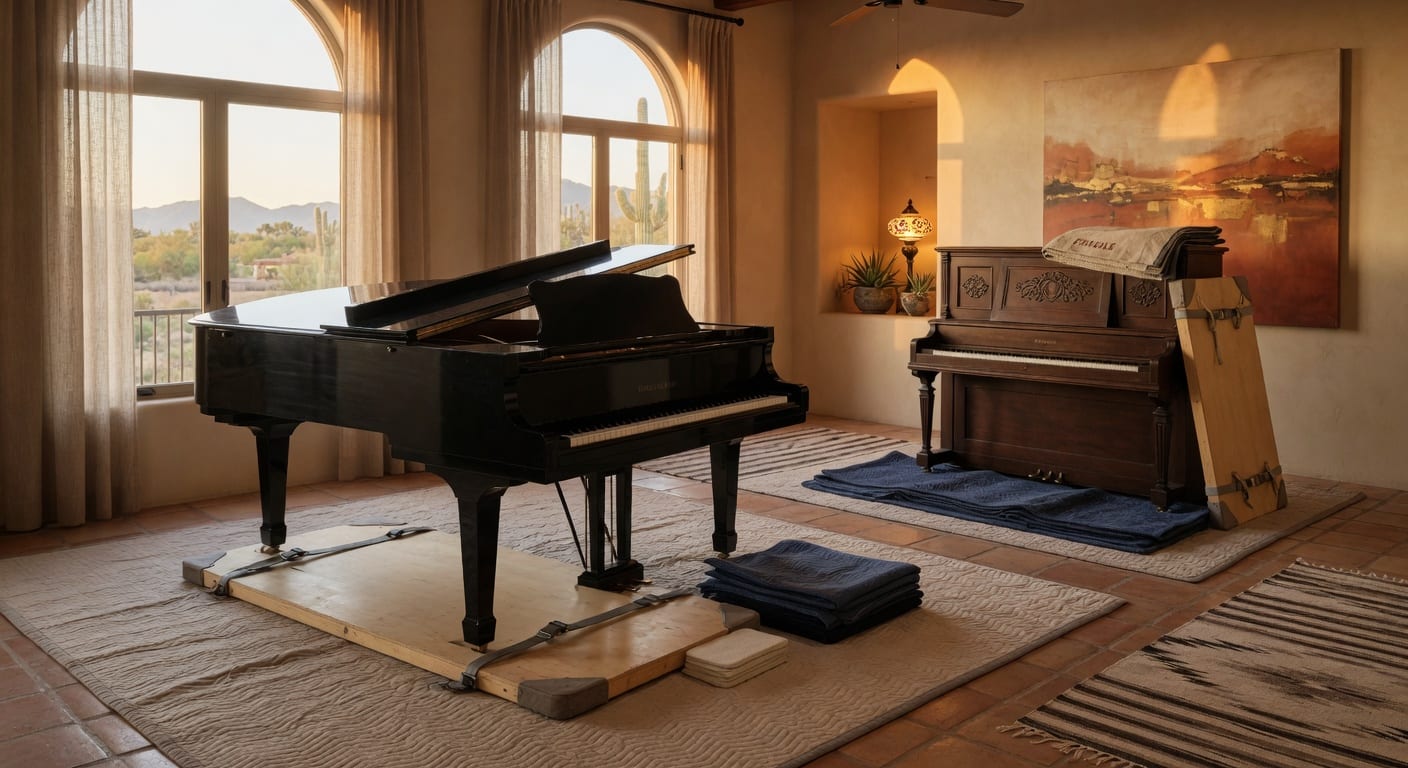
Grand pianos and upright pianos create different moving problems. A grand is wider, more exposed, and usually needs partial disassembly. An upright is more compact, but it can still be extremely heavy, top-sensitive, and risky around stairs or tight turns.
Grand piano moving
Grand and baby grand piano moves usually involve protecting or removing parts such as legs, pedal lyre, lid, and music rack depending on the route and piano. The piano may need to be placed on a board, padded, strapped, moved through the route, transported carefully, then reassembled and placed in the new room.
The big issues are finish protection, balance, parts protection, floor protection, and controlled handling. A grand piano should not be treated like a table with a keyboard attached. It is an instrument with high-value components and awkward weight distribution.
Upright piano moving
Upright, console, studio, and spinet pianos are vertical, but that does not make them easy. They are dense, awkward, and hard to control on stairs or raised thresholds. The cabinet, pedals, keys, casters, and finish still need protection.
Uprights often create problems in tighter homes because the move happens through hallways, doors, stair landings, and corners where there is not much room to adjust. A good upright move is about balance and route planning, not just strength.
Which move is harder?
It depends on the piano and the route. A baby grand in a wide single-story home may be cleaner than a tall upright going up a narrow staircase. A studio piano across town may be simple, while a grand piano with tight turns, stairs, or delicate floors needs more crew planning.
What details matter for both
- Piano type and approximate size
- Whether the piano is going up or down stairs
- Doorway width, stair width, landings, elevators, and tight turns
- Flooring and wall protection concerns
- Pickup and delivery cities
- Photos of the piano and route
Why this matters for quotes
A mover cannot quote accurately from “it is just a piano.” Grand, baby grand, upright, console, studio, and spinet all mean different handling. The route can matter even more than the instrument. Better details lead to cleaner scheduling, better crew planning, and fewer move-day surprises.
Need help identifying your piano?
If you are not sure what type you have, send a photo or call with the brand, shape, height, and room access. Gilbert Piano Movers can help sort out what kind of move you are dealing with before the crew arrives.
Call (480) 386-1783